
GENERATE MORE ALPHA
FROM ALTERNATIVE DATA
Accelerate your alternative data pipeline with AI agents that automate discovery, mapping, and engineering.

Platform-Agnostic AI Data Engineering
Choose your environment and deploy our autonomous AI Agents wherever your data engineering happens.




INTEGRATES NATIVELY WITH YOUR EXISTING DATA STACK













Genesis Data Engineering Agents
Run securely in your data environment, using the tools your data engineers already use, to do the work where their data already lives.
Let's talk about scaling alternative data for your fund's next chapter
You're managing $10B+ in AUM and expanding your alt data program—our team specializes in helping quantitative funds build scalable data pipelines that match their ambition.
Meet Your Expert
YOUR ACCOUNT EXECUTIVE
The Genesis team has partnered with quantitative hedge funds to scale their data pipelines. They understand the complexity of entity resolution, schema drift, and vendor onboarding while personalizing for multiple data verticals and buying committees.
What we'll cover:
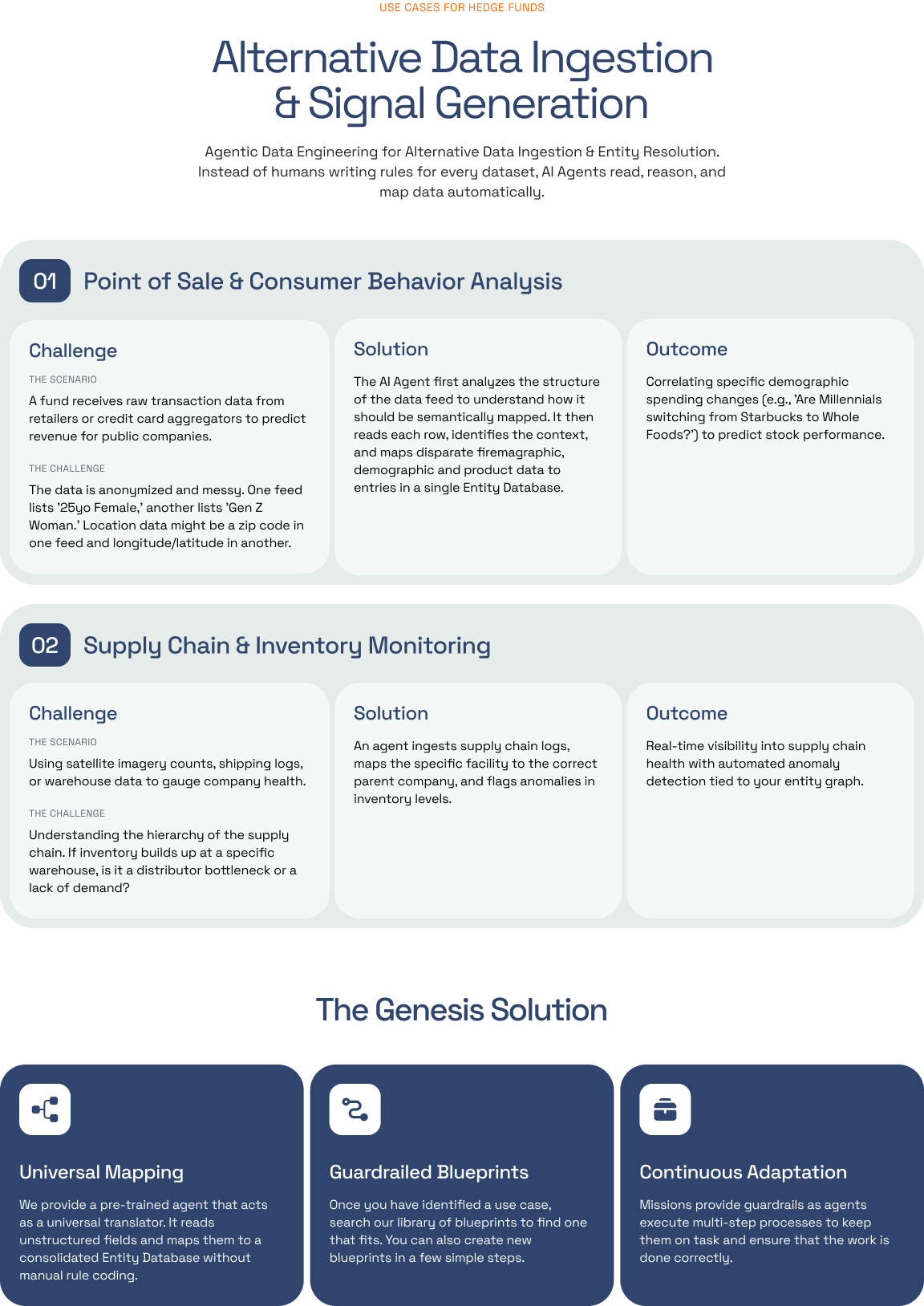
Automating alternative data discovery and entity mapping at scale
Building resilient pipelines that handle schema drift automatically
Reducing engineering effort from months to days per new data feed
Customer Case Study

INDUSTRY
Hedge Fund / Financial Services
LOCATION
New York
BUSINESS MODEL
Data-Driven
GENESIS COMPUTING PRODUCT CATEGORIES USED
Data Engineering
Analytics
AUM
~$5B
Multi-Agent Processing of Alternative Data Feeds
A New York hedge fund managing $5B in assets under management, looking to streamline its research program, incorporating alternative data feeds.
Client Context
The hedge fund had expanded its research program to incorporate alternative data feeds—including point-of-sale logs, foot-traffic telemetry, supply-chain traces, mobile activity, and e-commerce streams. Each feed required custom ingestion logic, entity resolution against the fund's internal graph, and mapping to a canonical schema before analysts could run queries or train prediction models.
These datasets arrived in inconsistent formats—schema variations, non-standard field names, missing metadata, and frequent drift often in semi-structured json. Mapping vendor identifiers (e.g., merchant IDs, store codes, product SKUs) to the fund's internal entity graph was partially automated with extensive manual override. As the vendor roster expanded from a handful to dozens, bespoke ingestion code became the primary bottleneck.
Problem Summary
The team encountered:
Inconsistent schemas across providers
Non-standard field naming
Missing or partial metadata
Non-uniform geographic and demographic encodings
Frequent schema drift
Fully manual entity resolution and mapping
Each feed required bespoke PySpark notebooks, custom entity-mapping scripts, and one-off quality checks. The result was fragmented logic scattered across repos, slow onboarding cycles, and brittle pipelines that broke whenever vendors updated their formats.
Genesis Intervention and Onboarding Effort
Genesis Computing deployed its multi-agent platform into the client's AWS VPC. The system runs alongside the fund's data lake environment, containing raw vendor feeds, and integrates with their dbt infrastructure.
Deployment and configuration included:
1
Environment Setup: Installed Genesis within the client VPC, configured Databricks connection
2
Blueprint Creation: Co-developed a declarative blueprint defining how feeds should be discovered, mapped, and ingested, starting from the Genesis-provided Source to Target mapping blueprint
3
System Integration: Connected Genesis to the fund's dbt repository
4
Initial Validation: Ran the system on three existing feeds to learn about correct mapping and output
Total client effort stayed under 10 hours—two sessions of 60-90 minutes each. From that point forward, the system operated autonomously, ingesting new feeds and handling schema changes without human code review.
Story Highlights
Ingestion latency: Reduced from 3-4 weeks to 3-5 days
Human-written code: Reduced by 60-70%
Pipeline delivery speed: 4-6x faster
Drift resilience: ~80% schema changes handled automatically
Outcomes
Across the first two datasets:
Ingestion latency
Reduced from
~3–4 weeks
to 3–5 days
~3–4 weeks
to 3–5 days
Human-written code
Reduced by
~60–70%
~60–70%
Pipeline stability
Resilient to
schema drift
schema drift
Throughput
Multiple
data pipelines generated in parallel
data pipelines generated in parallel
Engineering Takeaways
The system succeeded because it integrated tightly with the client's existing stack (Databricks, dbt), operated within their VPC for security, and required minimal configuration effort. The declarative blueprint abstracted complexity while preserving flexibility, clients can override mappings, add custom transforms, or inject domain-specific rules. The agent architecture separated discovery (understanding the data) from engineering (building the pipeline), allowing each agent to specialize and iterate independently. Pull-request-based approval workflows gave the data team control without forcing them to write code. The result: alternative data ingestion became a scalable, repeatable process rather than a manual, per-feed effort.
ROI Summary
Faster cycles translated into clear operational and cost impact:
Payback period
2 to 3 quarters
Dataset capacity
1–2 feeds/month to 5–6 feeds/month
Pipeline delivery speed
4–6x faster
Drift resilience
~80% schema changes handled automatically
Engineering effort
80–120 hours to ~25 hours per dataset
Headcount avoidance
Avoided hiring 1 data engineer (~$200K/year)
Overall Impact
By automating discovery, mapping, and pipeline generation, Genesis Computing enabled the hedge fund to scale its alternative data program without proportional increases in engineering headcount. The research team gained access to more datasets, faster, with higher confidence in data quality. The data engineering team shifted from writing bespoke ingestion code to reviewing and approving agent-generated pipelines—a higher-leverage activity. The fund's ability to react to market opportunities improved as new datasets became available to analysts in days rather than weeks. The agentic data engineering system delivered faster research cycles, lower operational overhead, and a defensible competitive advantage.
OTHER CONTENT IN THIS STREAM
VIDEO
ENHANCING DATA ENGINEERING PRODUCTIVITY WITH BLUEPRINTS
VIDEO
DEPLOYMENT OPTIONS
FOR GENESIS
FOR GENESIS
VIDEO
THREADS VS. MISSIONS
IN GENESIS: WHEN TO CHAT, WHEN TO AUTOMATE
IN GENESIS: WHEN TO CHAT, WHEN TO AUTOMATE
Nomad Malin, 387 Park Ave S, New York, NY
Copyright © 2026 Genesis Computing